
New Mexico: Winter in the Land of Enchantment

Central New Mexico is  known as the Rosy-Finch capital of the World!


Every winter, all three species of Rosy-Finch migrate south and converge on the Sandia Crest of Albuquerque, New Mexico. This amazing site hosts hundreds of these beautiful finches from November to March each year and has quickly become the worlds premier location to find these elusive mountain specialists. The Sandia Crest also has the added bonus of hosting the Sandia Rosy-Finch Project. This research project, supported by Rio Grande Bird Research Inc. and spearheaded by Raymond VanBuskirk and Michael Hilchey, is the largest winter Rosy-Finch ecology study of its kind. The tour also includes a trip to the world famous Bosque del Apache National Wildlife Refuge. “Bosque,” as the locals call it, is well known for its huge wintering Sandhill Crane and Snow Geese flocks. Bosque also offers some of the best birding in the southwest as well as some of the most breathtaking scenery! Join BRANT as we explore the snowy mountain home of the Rosy-Finches, the frozen marshes of Bosque del Apache, and the many other jewels that Central New Mexico has to offer!


Dates                                                                                                                                                                                       Cost

5 Days & 4 Nights                                                                                                                                                                                  $1,397 (+ tax)

2016: January 13th – 17th                                                                                                                  See pricing details under the “Payments” tab                                                                                                                   
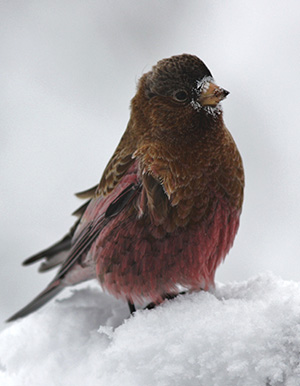
Brown-capped Rosy-Finch

Brown-capped Rosy-Finch

Day 1

Transfer to hotel for check in upon arrival. The tour begins at 3:00 pm in Albuquerque. We will kick off the trip by visiting a popular birding site in the shadow of the Sandia Mountains. This mixture of pinion-juniper woodland and desert scrub and is a fantastic spot for finding some of the Southwest’s  trademark species. These include Rock, Canyon and Cactus  Wren, Curved-billed and Crissal Thrashers, Western Scrub-Jay, Bushtit, Juniper Titmouse, Mountain and Western Bluebird, Scaled Quail, Greater Roadrunner, Townsend’s Solitaire, and Canyon Towhee. In recent years this has been a reliable spot to find over-wintering Black-chinned Sparrows and large numbers of Rufous-crowned Sparrows. We will break for dinner at a local restaurant and return to the Nativo Lodge for an early evening social before retiring. Night in Albuquerque.


Day 2

We will begin the day birding the beautiful riparian habitat found along the Rio Grande (Spanish for Big River), in the heart of Albuquerque. Here we will be treated with a mix of waterfowl including close-up views of Wood Duck, Ruddy Duck, Green-winged Teal, Northern Shoveler, Pied-billed Grebe, and Hooded Merganser as well as an assortment of other birds including: Greater Roadrunner, Belted Kingfisher, Northern “Red-shafted” Flicker, Black-capped and Mountain Chickadees, Eastern Bluebird, White-breasted Nuthatch, Bewick’s Wren, Yellow-rumped “Audubon’s” Warbler, Spotted Towhee, White-crowned and White-throated Sparrows, Pine Siskin, and American Goldfinch. This is one of the best places in the state to view Canada and Cackling Geese together, and allows for the chance to study these difficult to ID species up close and personal. After Lunch we will head south to Elephant Butte Lake.  We will make a quick stop at the Sevilleta NWR for Sage Sparrow and Sage Thrasher as well as Chihuahuan Raven. Elephant Butte Lake is a large reservoir located at the north end of the Chihuahuan Desert and is a great location for waterbirds and many desert specialties as well. Targets here will include: Common and Red-breasted Mergansers, Clark’s and Western Grebes, Neotropic and Double-crested Cormorants, American White Pelican, Pyrrhuloxia, Virden, Black-tailed Gnatcatcher, Vermilion Flycatcher, and Phainopepla. Elephant Butte is also well known as the Gull capitol of NM. We will spend some time searching through the many roosting Herring, Ring-billed, and California Gulls on the lake in hopes of finding something a bit more exciting. Bonaparte’s, Thayer’s, Mew, Lesser Black-backed, and Glaucous Gull are always a small possibility here in the winter. Dinner will be at a local restaurant in Truth or Consequences. After dinner we will look for Western Screech-Owl and Great Horned Owl along the Rio Grande before heading back to Socorro to check in to the hotel. Night in Socorro.


Day 3 

Today we will have a pre-dawn breakfast at the hotel before taking the short drive to Bosque del Apache NWR. Our first stop will feature thousands-upon-thousands of Snow Geese, Ross’s Geese and Sandhill Cranes as they leave their nighttime roosts to feed in the fields north of the refuge. This will be the coldest and earliest morning of the trip, but well worth the harsh conditions as the fog-lined ponds echo with the deafening noise of restless waterfowl, and the colorful morning skies become blanketed with the golden-rimmed silhouettes of thousands of cranes and geese! This spectacle, known as the “fly-out,” is a must-see and one of the highlights of our New Mexico tour! Once we’ve finished our coffee and are satisfied with our views of the fly-out we will head out to explore the rest of this magnificent refuge. Bosque del Apache features an array of wetlands, marshes, and waterways that offer some of the best birding anywhere in the middle Rio Grande Valley. The refuge is well known for its winter raptor-watching potential and, on a good day, one can expect to see Bald and Golden Eagles, Northern Harrier, Ferruginous, Red-tailed, Cooper’s, and Sharp-shinned Hawks. American Kestrel, Merlin, Peregrine, Prairie and Aplomado Falcons are also frequent visitors (these Aplomado Falcons are captive-bred birds that were released south of the refuge as part of a recent Peregrine Fund rehabilitation program, and are not officially countable by ABA standards). Bosque has also hosted such rarities as Rough-legged Hawk, wintering Harris’s Hawk, and White-tailed Kite. Other targets here include multiple species of waterfowl, namely: Bufflehead, Canvasback, Redhead, Ring-necked Duck, Lesser (and sometimes Greater) Scaup, Northern Pintail, and Eared Grebe.  Multiple species of sparrows, blackbirds, and finches also choose to call this refuge their winter home. The refuge has hosted a suite of winter rarities as well, including: Groove-billed Ani, Ruddy Ground-Dove, Prothonotary Warbler, and Yellow-throated Warbler, just to name a few, so, as you can see, the possibilities are endless. We will spend the afternoon searching for wintering sparrows including: Chestnut-collared, McCown’s, and Lapland (rare) Longspurs, as well as Vesper, Savannah, Brewer’s, and Chipping Sparrows. We’ll also look for other grassland species such as Prairie Falcon, Merlin, Golden Eagle, Loggerhead Shrike, Horned Lark, Eastern “Lillian’s” Meadowlark, and Sprague’s Pipit (rare). We will then head to Socorro for dinner followed by a drive back to the Nativo Lodge in Albuquerque for the night.
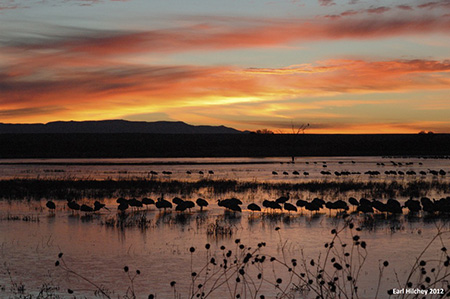
 

Sunrise at Bosque del Apache NWR

Sunrise at Bosque del Apache NWR

Day 4

We’ll have an early breakfast at the lodge this morning followed some birding in Albuquerque. After we’ve finished birding in town we will begin to make our way up the Sandia Mountains stopping at many sites en route to the Sandia Crest House. This morning we will we have a good chance at finding Pygmy Nuthatch, Cassin’s Finch, Stellar’s Jay, Red Crossbill, Red-naped and Williamson Sapsuckers, Juniper Titmouse, Townsend’s Solitaire, Mountain Chickadee, Western Bluebird, Hairy Woodpecker, Evening Grosbeak, Pine Grosbeak (rare), Red-breasted Nuthatch, Golden-crowned Kinglet, Brown Creeper, and Clark’s Nutcracker. In recent winters, Band-tailed Pigeon and Northern Goshawk ave been found at middle and high elevations in the Sandia’s, but they are not present every year. Our next and final stop will be at the Sandia Crest, situated at 10,678 feet above Albuquerque and the winter home of the Black, Brown-capped and Gray-crowned Rosy-Finches (including the interior and Hepburn’s subspecies). Here we will have the unique opportunity of observing all three Rosy-Finch species as they come in to feed at the feeders. BRANT guides Raymond and Michael, along with volunteers from Rio Grande Bird Research Inc., have been capturing and banding the Rosy-Finches at Sandia Crest for almost a decade in order to better understand their winter ecology. You will have the once in a lifetime experience of seeing these birds up-close, in-the-hand, as the research team captures and collects valuable data on these unique species. We will give you the run-through story of our past, present, and future research and you may even have the opportunity to release one of these birds back in to the wild. After a box lunch at the Sandia Crest, participants will have the option to go looking for the American Three-toed Woodpecker. This will be the most strenuous hike of the trip, and will likely involve walking on snow and/or ice. Participants may choose to opt out of this hike and continue to watch the Rosy-Finches at the crest house.  Around mid-afternoon we will return to Albuquerque for a few hours rest at the Nativo Lodge before our final dinner of the trip. If there is interest (and energy) after dinner we will have the option of heading back up the Sandia Mountains to look for Northern Saw-Whet Owls. Night in Albuquerque.


Day 5

The tour concludes this morning in Albuquerque.


Although we will typically adhere to the above itinerary, the exact schedule of the tour is liable to change depending on local conditions and of course the birds!

 

Trip Reports

Click on a link to see trip report

**NEW** New Mexico Winter in the Land of Enchantment 2015 Trip Report (Click Here for PDF version) **NEW**


Photos

Coming soon…


(The checklist can also be viewed and printed as a PDF file by clicking this link: Coming soon…)

Bold species will most likely be seen on this tour

Non-bold species are only sometimes seen on this tour

Starred* species have occurred at least once, but are very unlikely on this tour


Ducks, Geese, & Swans

  • Greater White-fronted Goose
  • Snow Goose
  • Ross’s Goose
  • “Richardson’s” Cackling Goose
  • Canada Goose
  • Tundra Swan*
  • Wood Duck
  • Gadwall
  • American Wigeon
  • Mallard
  • Cinnamon Teal
  • Northern Shoveler
  • Northern Pintail
  • Green-winged Teal
  • Canvasback
  • Redhead
  • Ring-necked Duck
  • Greater Scaup
  • Lesser Scaup
  • Bufflehead
  • Common Goldeneye*
  • Hooded Merganser
  • Common Merganser
  • Red-breasted Merganser
  • Ruddy Duck

Quails

  • Scaled Quail
  • Gambel’s Quail

Pheasants & Turkeys

  • Ring-necked Pheasant (I)
  • Wild Turkey

Loons

  • Common Loon*

Grebes

  • Pied-billed Grebe
  • Horned Grebe*
  • Eared Grebe
  • Western Grebe
  • Clark’s Grebe

Cormorants

  • Neotropic Cormorant
  • Double-crested Cormorant

Pelicans

  • American White Pelican

Herons & Bitterns

  • American Bittern*
  • Great Blue Heron
  • Great Egret
  • Snowy Egret
  • Cattle Egret*
  • Green Heron*
  • Black-crowned Night-Heron

Ibis & Spoonbills

  • White-faced Ibis*

Ospreys

  • Osprey*

Kites, Eagles, & Hawks

  • White-tailed Kite*
  • Bald Eagle
  • Northern Harrier
  • Sharp-shinned Hawk
  • Cooper’s Hawk
  • Northern Goshawk*
  • Harris’s Hawk*
  • Red-tailed Hawk
  • Ferruginous Hawk
  • Rough-legged Hawk*
  • Golden Eagle

Rails, Gallinules & Coots

  • Virginia Rail
  • Sora
  • Common Gallinule (Moorhen)
  • American Coot

Cranes

  • Sandhill Crane

Plovers

  • Killdeer

Sandpipers

  • Spotted Sandpiper
  • Greater Yellowlegs
  • Lesser Yellowlegs
  • Least Sandpiper
  • Long-billed Dowitcher
  • Wilson’s Snipe

Gulls & Terns

  • Bonaparte’s Gull*
  • Mew Gull*
  • Ring-billed Gull
  • California Gull
  • Herring Gull
  • Thayer’s Gull*
  • Lesser Black-backed Gull*
  • Glaucous Gull*

Pigeons & Doves

  • Band-tailed Pigeon*
  • Eurasian Collared-Dove (I)
  • White-winged Dove
  • Mourning Dove
  • Inca Dove

Cuckoos & Roadrunners

  • Greater Roadrunner

Barn Owls

  • Barn Owl*

Typical Owls

  • Western Screech-Owl
  • Great Horned Owl
  • Northern Pygmy-Owl*
  • Burrowing Owl*
  • Northern Saw-Whet Owl

Kingfishers

  • Belted Kingfisher

Woodpeckers

  • Williamson’s Sapsucker
  • Yellow-bellied Sapsucker*
  • Red-naped Sapsucker
  • Ladder-backed Woodpecker
  • Downy Woodpecker
  • Hairy Woodpecker
  • American Three-toed Woodpecker
  • Northern “Red-shafted” Flicker

Falcons

  • American Kestrel
  • Merlin
  • Aplomado Falcon* (I)
  • Peregrine Falcon
  • Prairie Falcon

Tyrant Flycatchers

  • Black Phoebe
  • Eastern Phoebe
  • Say’s Phoebe
  • Vermilion Flycatcher

Shrikes

  • Loggerhead Shrike

Jays & Crows

  • Pinyon Jay
  • Steller’s Jay
  • Western Scrub-Jay
  • Clark’s Nutcracker
  • American Crow
  • Common Raven
  • Chihuahuan Raven

Larks

  • Horned Lark

Chickadees & Titmice

  • Black-capped Chickadee
  • Mountain Chickadee
  • Juniper Titmouse

Verdins

  • Verdin

Bushtits

  • Bushtit

Nuthatches

  • Red-breasted Nuthatch
  • White-breasted Nuthatch
  • Pygmy Nuthatch

Creepers

  • Brown Creeper

Wrens

  • Cactus Wren
  • Rock Wren
  • Canyon Wren
  • Bewick’s Wren
  • Winter Wren*
  • Marsh Wren

Gnatcatchers

  • Black-tailed Gnatcatcher

Kinglets

  • Golden-crowned Kinglet
  • Ruby-crowned Kinglet

Thrushes

  • Eastern Bluebird
  • Western Bluebird
  • Mountain Bluebird
  • Townsend’s Solitaire
  • Hermit Thrush
  • American Robin

Mockingbirds & Thrashers

  • Northern Mockingbird
  • Sage Thrasher
  • Curve-billed Thrasher
  • Crissal Thrasher

Starlings

  • European Starling (I)

Pipits

  • American Pipit
  • Sprague’s Pipit*

Waxwings

  • Cedar Waxwing

Silky-Flycatchers

  • Phainopepla

Longspurs

  • Lapland Longspur*
  • Chestnut-collared Longspur
  • McCown’s Longspur

Wood Warblers

  • Yellow-rumped Warbler

Towhees & Sparrows

  • Green-tailed Towhee
  • Spotted Towhee
  • Rufous-crowned Sparrow
  • Canyon Towhee
  • Cassin’s Sparrow*
  • Chipping Sparrow
  • Brewer’s Sparrow
  • Black-chinned Sparrow*
  • Vesper Sparrow
  • Black-throated Sparrow
  • Sage Sparrow
  • Savanah Sparrow
  • Fox Sparrow*
  • Song Sparrow
  • Lincoln’s Sparrow
  • Swamp Sparrow
  • White-throated Sparrow
  • White-crowned Sparrow
  • Dark-eyed Junco

Tanagers, Cardinals, & Grosbeaks

  • Pyrrhuloxia

Meadowlarks & Blackbirds

  • Red-winged Blackbird
  • Eastern “Lillian’s” Meadowlark
  • Western Meadowlark
  • Yellow-headed Blackbird
  • Brewer’s Blackbird
  • Great-tailed Grackle
  • Brown-headed Cowbird

Finches

  • “Interior” Gray-crowned Rosy-Finch
  • “Hepburn’s” Gray-crowned Rosy-Finch
  • Black Rosy-Finch
  • Brown-capped Rosy-Finch
  • Pine Grosbeak*
  • Cassin’s Finch
  • House Finch
  • Red Crossbill
  • Pine Siskin
  • Lesser Goldfinch
  • American Goldfinch
  • Evening Grosbeak

Old World Sparrows

  • House Sparrow (I)

Health Considerations

New Mexico presents no major health hazards, however cold weather is a serious consideration as temperatures may reach well below zero on some mornings and at high altitudes . Also, high altitude can effect those who are from lower altitude states, or have any serious heart conditions. It is important that participants bring many layers of clothing for this trip including a heavy coat, gloves, warm socks, and a hat. Sturdy boots are also recommended.


Climate

Weather in winter in New Mexico can be highly variable. Temperatures may not get above freezing for the entire trip with lows well below zero, or temperatures may be quite mild with lows in the upper 30’s and highs in the upper 60’s. Rain and/or snow are also always possibilities. There is no saying what the weather might be so be prepared for anything!


Dress

Informal throughout. Multiple warm layers, along with warm gloves and hat, are a must for cold mornings and high elevation birding. Sturdy hiking boots will be needed for the hike for American Three-toed Woodpecker.


Group Size

Maximum group size is 12 participants, although 8 to 10 is typical. We usually have 2 guides for this tour.


Tour Pace

As with all birding tours, this trip will have early mornings and relatively full days of birding . Hiking is minimal, flat, and leisurely (with the exception of the hike for American Three-toed Woodpecker on the last day). Altitude will be a consideration as the Sandia Crest House is situated at almost 12,000 feet above sea level.


 Food

Meals will be taken at local restaurants throughout trip. Some breakfasts may be “to go” or may be simple continental breakfasts served at the hotel. We try to focus on local New Mexican cuisine wherever possible. Since the Crest House has been closed for the winter, a box lunch will be eaten on site or in the van.


Transportation

Our transportation will depend on how many participants we have. In any case we will have a comfortable rental vehicle appropriately sized for our group. We’re not sardines and we don’t expect you to be either.


Accommodations

Accommodations are in standard, 3-star hotels throughout the trip. Single occupancy is available throughout the tour for an additional charge. Single occupancy means you desire to have a room to yourself – no roommate, you will be charged the entire room rate.


Non-US Citizens

Non-U.S. citizens will need a valid passport and may need a tourist visa to enter the United States. You can locate the nearest U.S.Embassy or Consulate here.

Before deciding to register for this tour, please read over the the following information as well as the “What To Expect” tab on this page. After you have read  and understood the all important tour information please fill out the Registration Form at the bottom of this page and complete you payment under the “Payment” tab. Please note that your spot on the tour is not reserved until we have received your deposit in full. If you need help or have questions at any time feel free to contact us via email or phone.


What’s Included

The tour price includes all travel from the point of departure (Albuquerque International Sunport, Albuquerque, NM), all lodging while on the trip, all meals unless otherwise noted, tour materials, and all services of the tour leaders. Tips for included meals, porters, drivers, and other service providers are also included.

Lodging is booked on double occupancy, most lodging in the U.S. can allow us to arranged  for single rooms at an additional charge;  lodging outside of the U.S. is usually in small locally-owned lodges and will almost always be double occupancy. If you are traveling single we will match you to appropriate roommates and can discuss any changes once the group has established. Double occupancy means that you are sharing your room with another individual, single occupancy means that you are paying for the room for just yourself, and you do not want a roommate.

Items that are not included in the tour price are as follows: passports, visas, airfare , departure taxes, immunizations, baggage charges, telephone calls, alcoholic beverages, laundry services, room service, snacks, emergency evacuation fees and medical fees, and other personal purchases you desire to make in the course of the trip.


Travel to Point of Departure

Your fees include travel arrangements for the trip at/from point of departure. For example if your trip begins in Albuquerque, NM, you will need to make arrangements to get to Albuquerque, NM. From that point we will pick you up and provide all other transport. If you are traveling internationally we will provide you with suggested airline and travel times for you to book your flight. We will provide specific information about arrival and departure times in the trip packet sent to you after registration. If you would like assistance with your travel plans please feel free to contact us and we will help you out.


Gratuities

At BRANT we value our guides experience expertise and do everything we can to compensate them appropriately. We do not expect you to tip them, and they do not expect a tip (seriously, we are not offended), however if you feel as though they have gone above and beyond to help make your trip exceptional and wish to tip your guides, they would be more than happy to accept. At the end of the tour please present your tip to the lead guide at the appropriate time and he/she will make sure to distribute the tips fairly to all the guides.

Tips for hotel staff, servers, kitchen staff, local guides, drivers, and anyone else are included in the cost of the tour. We hope to eliminate any confusion for our participants by covering all tips in the cost of the tour. However, if you wish to tip above and beyond that you are more than welcome to do so.


Restrictions On Participation

In general there is only one absolute restriction to a nature tour, you absolutely cannot collect any plants, artifacts or animals during the tour.

Otherwise, there are no restrictions. We only ask that you let us know about any potential limitations or safety concerns that may hamper your ability to  participate in any aspect of the desired tour. For example, walking difficulties, diabetes, asthma, angina,  diet limitations, applicable phobias, etc. should be noted on the registration form. Our tours are typically not physically demanding however the level of physical difficulty for each tour is available under the “Pace of Tour” section of each tour.  If there is any question about your ability to participate on a tour we would be more than glad to provide more information that you and/or your doctor may need to help make that decision.  All hikes, on all tours, will be round trip, that is returning to the vehicle start point unless otherwise noted, allowing any participant to ‘sit one out’ if they feel inclined to do so. In addition to any walking, participants should be mindful that they will be required to be able to sit in any seat on our tour vehicles.


Tour Confirmation

Tour confirmation occurs at the time of invoicing or 3 months prior to the tour departure date. This tour will be confirmed no later than October, 2015.


Tour Cancellations

In the event a tour is cancelled by BRANT (due to civil unrest,  natural disaster, low participation, etc.) we will offer you an alternate tour option (same time/similar birding targets) or refund the full amount of your tour deposit and price.


Price Increase

Projecting the cost of a tour package months in advance is not an exact science. If unexpected increases do occur it may be necessary to charge participants up to 10% increases of the tour price. If greater than 10% increases are necessary, participants may withdrawal from the tour without penalty.


Refunds, Transfers, and Cancellations

We hope that you will be able to join us on this tour, however, if circumstances cause you to cancel your trip we understand. If cancellations are made 3 months before the start of your tour, your deposit, less the non-refundable amount, will be refunded to you. If cancellations are made after 3 months before the departure date, your deposit is not refundable. If cancellation is made 45 days  or less before the departure date all deposits and payments are non-refundable.

BRANT will allow a one-time transfer of a deposit to an upcoming tour date as long as the transfer takes place at least 45 days prior to tour departure date. Once a transfer has been made you will no longer be eligible for a transfer or refund of any amount at any time should you cancel again. Please contact us to discuss this option.


Registration Form

Please fill in all required fields. Remember that you must pay your deposit in addition to submitting this form before your spot on the tour is secured.If you have any questions or problems please contact us at anytime.

If you would prefer to fax or mail your registration form you can click here to print a hard copy. Our fax number and mailing address can be found here.

New Mexico – Winter in the Land of Enchantment Registration Form

Tour Departure Date


Contact & Travel Information

  • Please make sure to enter all information in full, and as it appears on your travel documents.
  • Primary Participant

  • Second Participant (Not Required)


Medical & Dietary Information

  • Please include any information that will help to to create the most safe and enjoyable experience possible.
  • Primary Participant

  • Second Participant (Not Required)


Emergency Contact

  • Please provide the name and contact information in case of emergencies while we are on tour. If this contact is the same for both participants you only need to enter it once.
  • Primary Participant

  • Second Participant (Not Required)


Accommodation Options

  • Please indicate your rooming preferences. Note that Single Occupancy rooms will incur an additional fee. If you do not have a travel partner but do not wish to pay the single occupancy supplement, BRANT will assign you a roommate. Contact us if you have any questions.
  • Primary Participant

  • Second Participant (Not Required)


Payment Method

  • Please indicate how you have submitted your deposit. Remember that your registration is not complete until you have submitted payment. To complete payment follow the instructions under the "Payments" tab at the top of this page.
 

How Did You Find BRANT?

  • Please indicated how you heard about us. You can select multiple answers if needed.
 

Notes


Verification

Cost

The price of this tour may vary by the selected tour date. Pricing is as follows:

January 13th, 2016

Price TBA. See last year’s cost below.

$1,397 (+ tax)

Single Occupancy Supplement – $250 ($1,547 Total + tax)

Deposit Due at Registration – $275


Payment

Deposits can be made either online via PayPal or by check. Payments by check carry a significant discount, applied at the time of invoicing.

Make checks payable to BRANT Tours and mail them to the following address

7522 Edith Blvd NE

Albuquerque, NM

87113

To pay the deposit online select your departure date below and click “Buy Now”

January 13th, 2016

Trip Material

After you successfully register for a trip we will send you an information packet that will include:

  • Detailed tour itinerary
  • Bird (or wildlife) checklist
  • Study/reference sheet
  • What to bring sheet
  • Receipt for deposit and invoice for remaining balance owed
  • Information regarding travel to and from tour departure location
  • Liability Waiver

Although your guides will be able to identify all of the wildlife for the area you are visiting, it is always a good idea for you to study up on the expected wildlife for your  trip.  If you want more information about any aspect of your trip prior to departure please contact us and we will be happy to answer any questions and/or recommend any reference guides


Liability Waiver

BRANT has selected known areas in the US and internationally, we cannot, however, guarantee anyone’s personal safety. For the most part ecotourism is done in remote, outback, and jungle like areas. The terrain is often rugged and local services and government assistance is not available in an emergency. In many out of the US areas there may not be phone or internet services for a day or two at a time during the trip. (However, in most established lodges internet service is readily available.) Therefore, we require that you accept your personal responsibility and agree to release us from liability for your safety within the limits of the law by completing the Assumption of Risk and Liability Agreement provided in your tour registration packet. This agreement must filled out and returned to us prior to the departure date of your tour. YOU MUST COMPLETE THE LIABILITY WAIVER TO PARTICIPATE ON ANY BRANT TOUR!

You can return the liability waiver to us via post or fax at anytime prior to your trip.

Liability Waiver (click to download PDF)


Health Preparations

Health precautions for trips in the US are minimal to none. If you have a health condition that requires medication please have the prescription filled for more than the numbers of days your trip encompasses, carry it in the original bottle, clearly labeled with instructions. If you have a health condition that you feel may affect your participation on the trip please discuss this with us so we can advise you and/or provide you with information to discuss with your physician.


Trip Insurance

Please check with your insurance agent for coverage you may already have and any limitations on national and/or international travel. Travel insurance may be purchased from several reliable companies; Travel Insured International (travelinsured.com) and Travelex (travelexinsurance.com) are two to consider. Travel insurance is purely voluntary and not required to participate on BRANT tours.


Conservation & Research

As with all of our tours, 10% of the profits from this trip will be donated to local education, research, and/or conservation efforts. For this particular trip we have decided to donate to the following causes:


The CNMAS Ryan Beaulieu Memorial Education FundThe CNMAS Ryan Beaulieu Memorial Education Fund

Through the Central New Mexico Audubon Society, the fund provides scholarships for youth between the ages of 13 and 20, or educators of youth, to attend a specific program, camp, or course, pertaining to the candidate’s interest in the natural sciences. This project is very dear to our hearts as Ryan was a close personal friend to Lee, Raymond, and Michael and was the original Principal, along with Raymond, of the Rosy Finch Research Project. Ryan was lost to us in a tragic accident in 2005. BRANT gives dollars to the fund to keep it strong and help it grow for future youth to explore their dreams in wildlife conservation and birding. Visit the web site CNMAS Page for more information or an application for the scholarship.
 

Rio Grande Bird Research Inc.Rio Grande Bird Research, Inc.

Rio Grande Bird Research has been banding birds since 1979 at the Rio Grande Nature Center in Albuquerque. This project has contributed thousands of valuable bird data to the North American Bird Banding Program at the Patuxent Wildlife Laboratory. RGBR is totally operated by volunteers who give their time and energy to continue this valuable contribution to studies of dispersal and migration, behavior and social structure, life-span and survival rate, reproductive success and population growth of North American birds. The RGBR is also the organization under which the Rosy Finch Project is administered. Raymond, Michael, and Lee are all active volunteers of the group and have received numerous hours of education and mentorship in bird banding from RGBR. BRANT gives dollars to help offset the costs of seed, Rosy Finch feeders and traps, mist nets, and banding tools needed to conduct the research. Visit the RGBR website  or the RGBR Facebook page for more information.